The Future of Financial Therapy
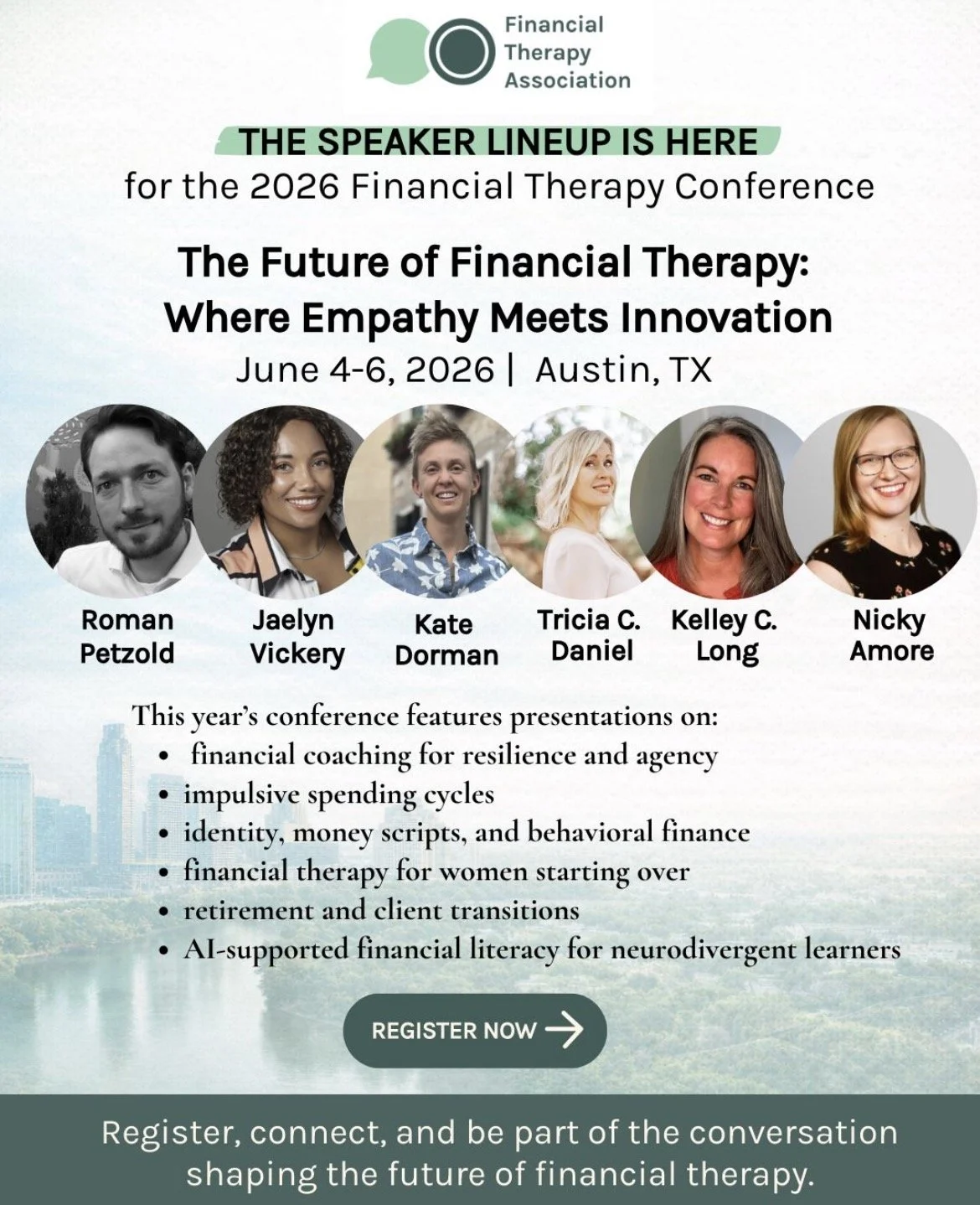
2026 Financial Therapy Conference speaker lineup featuring Jaelyn Vickery and industry experts in Austin, Texas.
This June, the Financial Therapy Association will bring together some of the most innovative minds in the field for the 2026 Financial Therapy Conference in Austin. Centered around the theme “The Future of Financial Therapy: Where Empathy Meets Innovation,” this year’s conference is more than just a gathering. It is a reflection of how far our field has come and where we are headed next.
I am incredibly honored to be returning as a speaker for the second year in a row. Not only is this where I earned my credential as a Certified Financial Therapist™, but it is also where I found a community that truly understands the deeper layers of money.
A Community Rooted in Collaboration
Financial therapy exists because we recognize something many traditional systems overlook. Money is emotional. It is relational. It is deeply tied to identity, survival, and well-being. No single professional, discipline, or framework can fully address that alone.
At the Financial Therapy Association, there is a shared understanding that we move the field forward together through collaboration, curiosity, and a commitment to bridging the gap between money and mental health. That is what makes this work so innovative and necessary.
Continuing The Conversation: Disordered Consumption™
Last year, I introduced my work on Disordered Consumption™, a concept grounded in both clinical experience and real-life patterns I have observed across food, money, and everyday decision-making.
At its core, Disordered Consumption™ is not about the act of consuming itself. We all consume. That is part of being human.
Disordered Consumption™ occurs when the way we consume or acquire resources becomes misaligned with our actual needs, often driven by emotional impulses rather than intentional choice.
It shows up when consumption becomes reactive instead of reflective. When we are not just meeting a need, but trying to (mis)manage a feeling. When the behavior gives short-term relief, but creates long-term disconnection. We do not just spend to survive. We consume to cope and connect. Sometimes to escape.
The C3 Cylce™ in action
This year, I am continuing that conversation through the framework I developed, the C3 Cycle™: Compulsion → Consumption → Control™.
The C3 Cycle™ helps us understand a pattern many of us experience:
Compulsion: The emotional or internal trigger that creates the urge to act. This can be stress, loneliness, fatigue, boredom, or anxiety.
Consumption: The action taken to relieve that feeling, such as spending, eating, scrolling, or seeking validation.
Control™: The attempt to regain a sense of stability after the behavior, often through restriction, overcorrection, or rigid rules.
Instead of resolving the issue, this often reinforces the cycle, pulling us back into compulsion again.
What makes the C3 Cycle™ powerful is that it shifts the focus from judgment to understanding.
It moves us from asking, “Why did I do that?”
to asking, “What was I actually needing in that moment?”
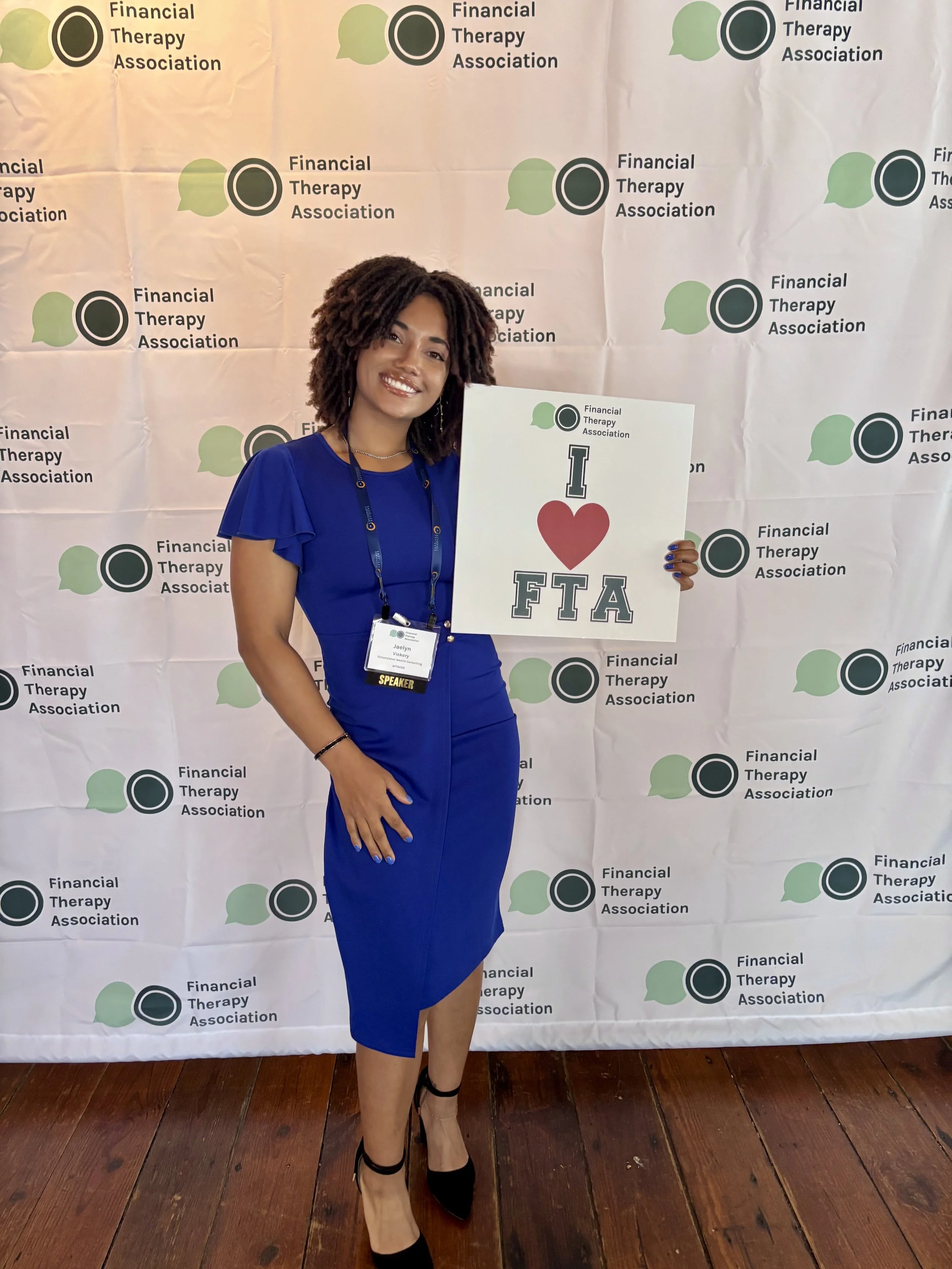
Dimensional Wealth founder and certified financial therapist™ Jaelyn Vickery speaking at the Financial Therapy Association (FTA) Conference.
My 2026 presentation, “Disordered Consumption™: Identifying Impulsive Spending Cycles in Food, Finance, and Retail,” builds on this framework by exploring how impulsive spending is not just a financial issue.
It is emotional. It is relational. It is influenced by the environments we are in and the systems we navigate.
In this session, we will explore how to:
Identify patterns of impulsive consumption across food, finances, and retail
Understand the emotional drivers behind spending behaviors
Shift from reactive habits to intentional, values-based decisions
Replace shame with curiosity, awareness, and self-regulation
We live in a world designed to keep us consuming
From constant digital stimulation to social expectations, we are continuously being pulled toward more. More spending. More comparison. More noise.
Without awareness, it becomes easy to fall into cycles that leave us feeling disconnected, overwhelmed, and out of control.
That is why financial therapy matters.
It gives language to what we are experiencing.
It helps us understand the patterns behind our behaviors.
And it creates space to respond differently.
Lasting financial freedom is not possible without financial healing.
join the conversation
If you are a practitioner, educator, or someone who wants to better understand your relationship with money, I invite you to explore this year’s conference.
You can learn more and register through the Financial Therapy Association. If you are looking for a financial therapist, their directory is a powerful place to start.
And if you are seeking more personalized support, whether you are navigating Disordered Consumption™, building financial confidence, or working toward alignment in your life, I invite you to connect with Dimensional Wealth.